



 16 / 68

14
ELECTRIC.IE• The Magazine & Website for the Irish Electrical Industry •
Preparing pharmaceutical and medical technology for the future
Mitsubishi Electric
-
Visit Mitsubishi Electric at Medtec Ireland Stand 401 to learn more
Ǥ
Ǣ
ơ ȋ
Ȍǡ
ơ
ȋ ȌǤ
ͤǤ͠
Ǥ
ͤǤ͠
The Internet of Things has found its
way into production in the form of
Industry 4.0: increasingly networked
systems with more communication-
capable components have meant an
ever-increasing volume of data. Thanks
to “big data”, production is being made
more and more intelligent, with the
pinnacle of achievement being the
smart factory. The key to success lies in
determining the right information from
the mass of data available, analysing
Ƥ
them. The aim of such Smart Data
Management is to optimise the plant in
question and prepare it for the future in
terms of site operational excellence.
In addition, overall equipment
ơ ȋ
Ȍ
an obvious trend. The main factors
that have contributed towards this have
been optimised plant utilisation and
productivity for which manufacturing
execution systems (MES) and enterprise
resource planning (ERP) are of vital
importance. Interfaces such as the MES
interface from Mitsubishi Electric enable
data to be collected quickly and easily
at plant level and transferred to higher-
level MES or ERP systems at the control
level for further analysis. OEE can be
Ƥ
results without the need for a gateway
PC to transfer the data. Based on the
System Q PLC from Mitsubishi Electric
Ƥ
plant engineer in just around 15 minutes.
Cost control strategies look for a more
compact design, shorter production
cycles and substantially minimised
waste. Automation technologies
strongly support these approaches with
robot technology in particular being
used to achieve these aims.
Today’s pharmaceutical and medical
technology production environments
see robots and human operators
increasingly working side by side.
Mitsubishi Electric’s integrated Robot
Safety Solution helps manufacturers
to boost productivity and lift human-
machine collaboration by allowing the
robot to continue operation, within
tight constraints, while operators access
its work cell. Safety sensing technology
Ƥ
zones within the operating environment
of the manufacturing cell and transmits
the information to the SafePlus safety
system. A reduced operating speed or
a movement stop is then assigned to
the robot in real time, thus enabling
operators to work in close proximity to
the moving robot without a safety cage.
As a result, humans and robots are able
to work within an environment where
the risk of danger is eliminated.
Ǧ ǣ
ǡ ƪ
Space is an expensive commodity,
especially in cleanrooms. The
manufacture and maintenance of these
plants where an extremely high level of
hygiene is required are extremely costly.
Compact components are all the more
important as ultimately, the machine
needs to be space-saving. Mitsubishi
Electric components such as SCARA
and articulated arm robots, controllers
and servo drives are characterised by
their particularly space-saving design
ƪ
even when space is restricted. Easy
handling enables fast integration,
commissioning and adjustment.
One example of a highly compact
handling solution came from
Robotronic AG. Their required a
secondary packaging solution for
Ƥ
various sizes. The solution needed to
be integrated in an existing system with
limited available space. The modular
design principle of the modular
robot technology (MRT) produced by
Robotronic provides excellent design
ƪǤ ǡ
for the MRT cell has a footprint of just
1.0 x 1.30 metres and is approximately
2.20 metres high, so it also meets the
minimal space requirements. The
solution for the cleanroom class in
accordance with GMP standard level
D consists of two MRT cells, each
with a compact robot from Mitsubishi
Electric and a conveyor line with
eight positioning screws, driven by
Mitsubishi Electric servo motors. The
robots place the vials in the blister packs
at a processing speed of 300 units per
minute.
The increasing use of automation
technologies, especially robots, has
led to an increase in the demand for
systems which meet high cleanroom
requirements. It is also just as important
to be able to clean a plant before a
production changeover without any
major costs being incurred. That means
that it must be possible to clean the
components in place (i.e. be CIP-
compatible) using aggressive chemicals
like H2O2. For that reason, Mitsubishi
ơ Ǧ
resistant versions of its new generation
of MELFA robots which have been
approved for regular CIP cleaning
using H2O2. MELFA robots can even
meet cleanroom class requirements;
ISO 3, are dust proof, and have IP67
environmental protection.
For more information visit Mitsubishi
Electric at Medtec Ireland Stand 401 to
learn more.
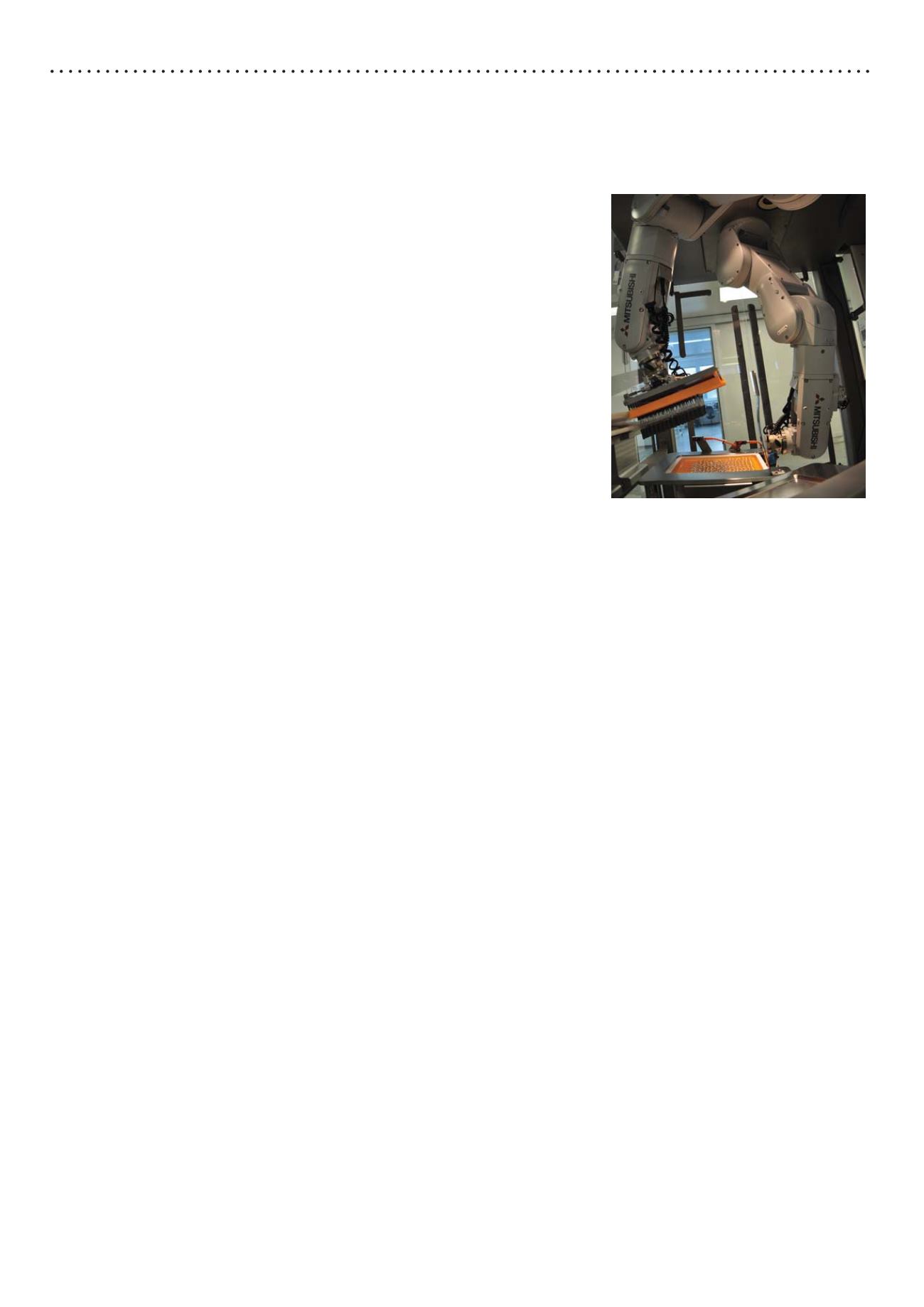
Robots are increasingly taking on handling tasks to
reduce human effort in the medical/pharma sectors,
for example by supplying filled syringes to the
end-of-line packaging station