



 28 / 68

26
ELECTRIC.IE• The Magazine & Website for the Irish Electrical Industry •
Automatic Transfer Switches
W
Ǥ
ȋ Ȍ
Ǥ
The Mains (or Primary) supply is
constantly monitored and should
it fail or fall outside of pre-set
values (i.e voltage too low/high)
the ATS will send a signal to start
the Generator and then switch the
load to the backup source when
it is available. In highly critical
environments the ATS will more
likely be switching between two
Mains supplies which are supplied
through a UPS (Uninterruptable
Power Supply).
Automatic Transfer Switches (ATS)
are covered by IEC 60947-6-1 which
states that the ATS must be a single
complete manufactured product
(as opposed to switching device
and separate control circuit). Up
until recent years it was common
to use a means of switching
(Contactors, ACBs, MCCBs or
Changeover Switch) with a separate
control circuit which combined
Timers, Phase Failure Relays and
Contactors. The problem with this
solution is that there is no standard
way to assemble the control circuit,
meaning that upon failure of the
circuit (usually at the worst possible
time when transfer to the backup
supply is required) an engineer may
ǦƤ Ƥ
the problem. During this time there
may be no possibility to change to
the backup supply.
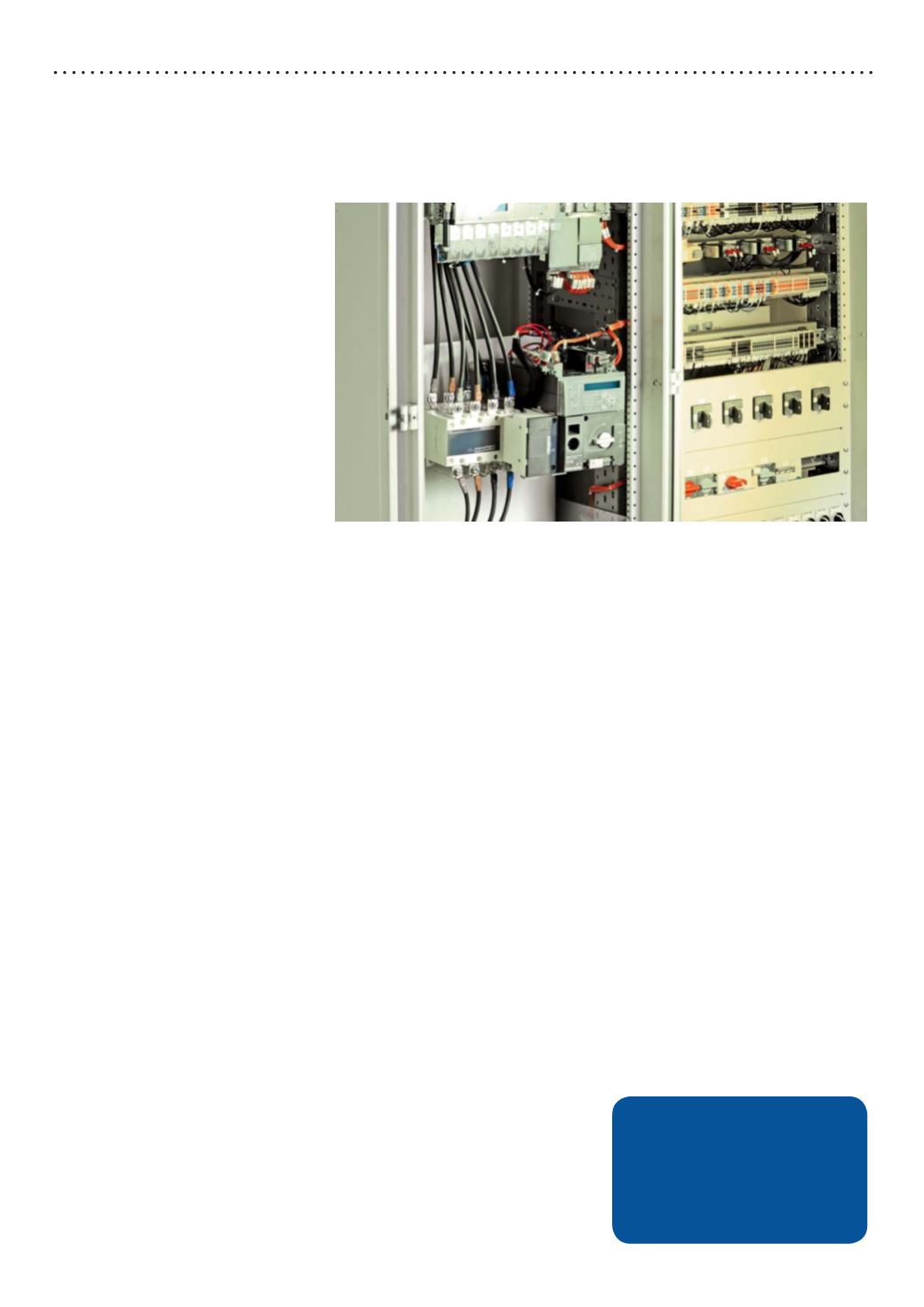
Socomec’s new ATyS range meets
and exceeds the IEC 60947-6-1
standard. They combine a Switch,
Motor and Control module into one
ơǦǦ
is ready for installation into an
enclosure or distribution board.
ATS’s not only handle the switching
of supplies in the event of failure,
but also in other situations where
the automatic transfer of supplies
is necessary. In some cases the
supplies may need to be periodically
alternated (i.e. sharing the load
equally between two Generators) or
the use of the backup Generator is
incentivised (utility company may
ơ
load at peak times). For this level
of automation you will need an
advanced ATS.
In a critical environment it is
important to install the best
possible ATS. Socomec’s ATyS P
not only monitors the voltage and
frequency of the supply but also
the current and power (through
ǯȌǤ Ƥ
an Ethernet module you can access
its on-board webserver to view
power measurements, a history
of time-stamped events, and also
schedule or instantly command
the switch to change position or
Ǧ ơǦ
test. All of this information can also
be sent to a Building Management
System (BMS). There is also a
Load-Shedding feature. This is used
in situations where the backup
supply does not have the capability
to supply the entire load (usually
an undersized Generator). Before
switching to the backup supply a
signal is sent and the non-essential
loads are isolated.
The ATyS P has a self-diagnosis
ƪ
communicate any component issues
with its Motor or Control module.
In the event of an issue, both the
Motor and Electronic module can
be replaced without the need to
disconnect the supply, the ATyS
can still be operated manually
during this time. An ATyS is a fully
interlocked isolation device. Both
supplies can be isolated and the
switch padlocked in the “OFF”
position for building maintenance.
Single Phase and Three Phase
versions are available from 40A to
6300A.
Contact:
Garo Electric Ireland,
sales@garo.ie,
Ph: 01 - 866 5360,
for more information or a
demonstration.
Garo Electric Ireland